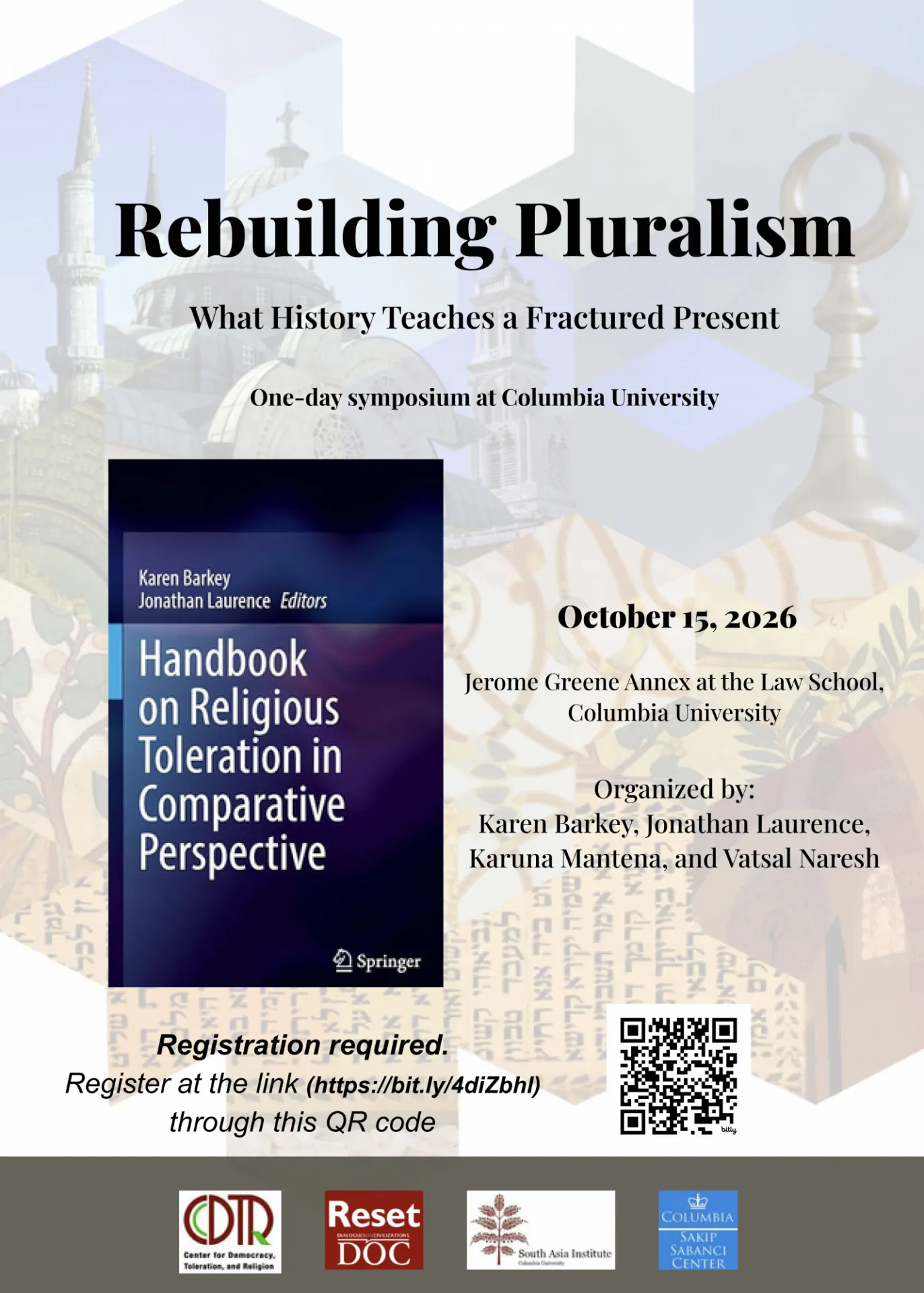
This one-day symposium celebrates the publication of the Handbook and asks what its history has to teach a present moment that badly needs it.
The Handbook began with a working group convened by Alfred Stepan at Columbia and grew through a network stretching from Berkeley to Boston College to Reset Dialogues in Italy. It offers a genuinely global record of how societies have managed diversity without recourse to violence, from from Ottoman kanunnames, Tibetan Buddhist toleration of Capuchin missionaries, Ashoka's edicts, to the European Court of Human Rights.
Democratization is again giving ground to authoritarianism, and religious nationalism is feeding discriminatory politics across the world. Leaders invoke a purified, mythical past to justify exclusion, and toleration is often seen as a uniquely Western legacy of Europe's religious wars. Against both views, the Handbook shows that toleration was practiced, debated, and institutionalized across empires, faiths, and centuries, from Qing China to Safavid Iran to West Africa. If pluralism has eroded before and been rebuilt, its current retreat is neither natural nor final. The historical record offers concrete models, vocabularies, and cautionary tales for those trying to rebuild it now.