Monday, September 30
A talk by Kartik Nair (Temple) on his new book,
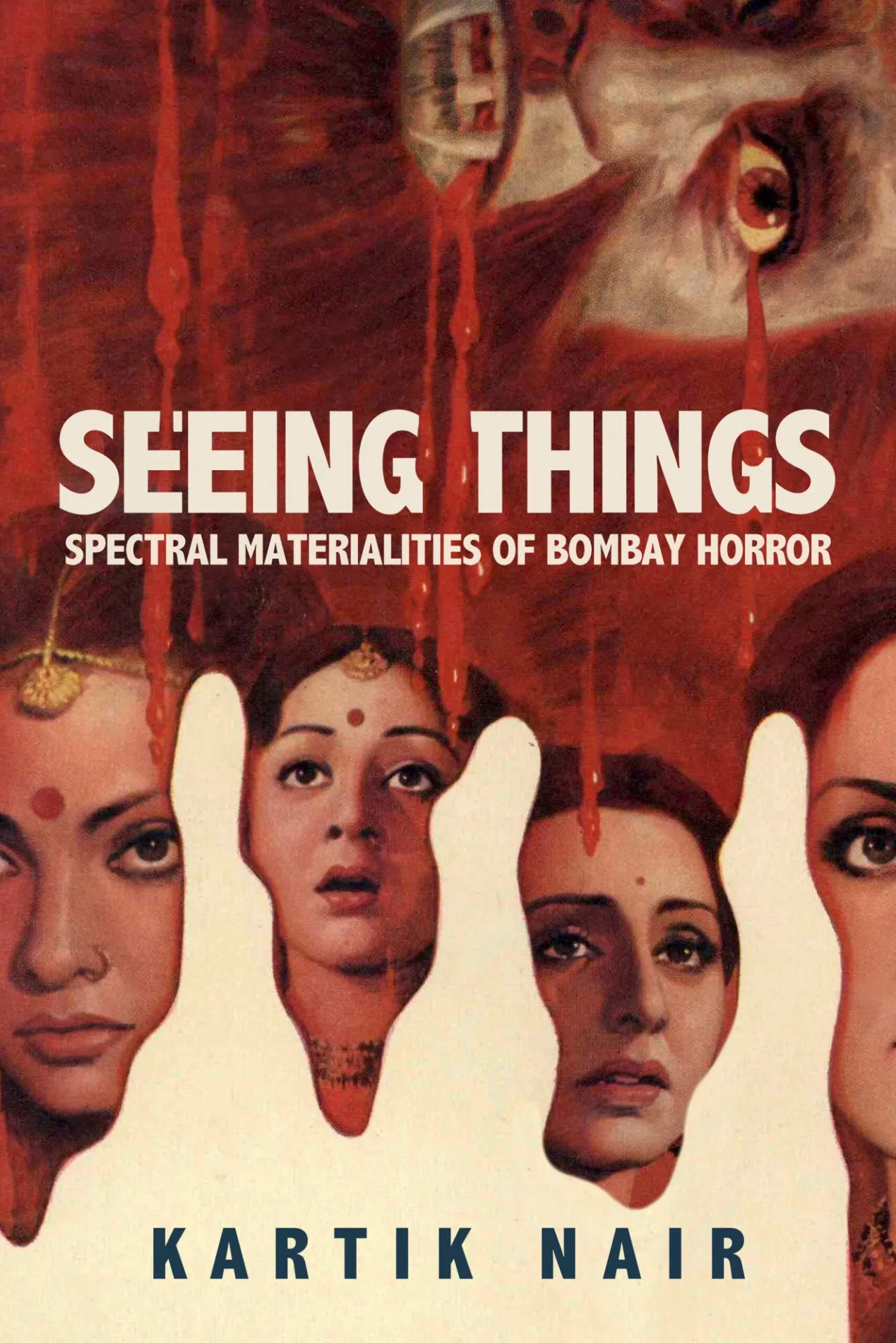
Seeing Things: Spectral Materialities of Bombay Horror (2024)
Discussant: Usha Iyer (Stanford) and Yilun Li (Doctoral candidate, Department of East Asian Language and Cultures)
Moderated by Debashree Mukherjee (MESAAS)
Time: 4:15pm - 5:45pm
Location: 208 Knox Hall, 606 West 122nd Street, between Broadway and Claremont
Kartik Nair is Assistant Professor of Film Studies at Temple University. His first book, Seeing Things, is a material history of low-budget horror films made in 1980s India. His writing has appeared in the Journal of Cinema and Media Studies, Film Quarterly, Discourse, and the Los Angeles Review of Books. He is one of the core editors of BioScope: South Asian Screen Studies, and his current research explores the physical pipelines of virtual imagery in contemporary blockbuster cinema.
Usha Iyer is Associate Professor of Film and Media Studies in the Department of Art and Art History at Stanford University. They are the author of Dancing Women: Choreographing Corporeal Histories of Hindi Cinema (Oxford University Press, 2020). Their current book project, Jammin’: Black and Brown Media Intimacies between India and the Caribbean, studies the affective engagements of Caribbean spectators with Indian cinema and the impact of Caribbean performance cultures on Indian film industries. They are co-editing the volume, Shift Focus: Reframing the Indian New Waves, with Manishita Dass.
Yilun Li is a Doctoral candidate in Chinese Cinema, Media, and Arts at the Department of East Asian Languages and Cultures (EALAC), where he is also pursuing a graduate certificate in Comparative Media through the Center for Comparative Media (CCM). He hails from China (B.A., Tsinghua University) and holds an M.A. in Film and Media Studies from Columbia University. Standing at the intersection of cinema and media studies, art history, and environmental humanities, his research investigates the politics and aesthetics of Chinese experimental media practices, with a particular focus on their entanglement with urban development, infrastructural construction, resource extraction, environmental degradation, and biopolitical governance.